
The platform
Sazinga Sarva
Seven business applications, each one standing on its own. Start with the one that matches the problem you have — same team, same stack, same standards, so they join up when you need them to.
The applications
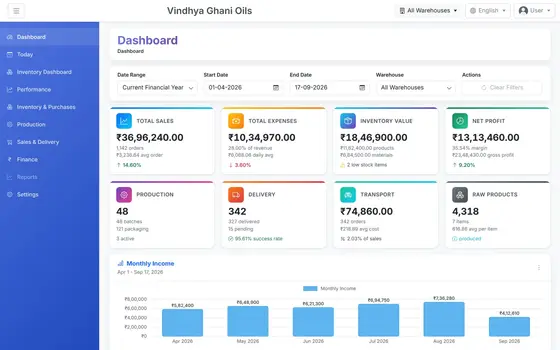
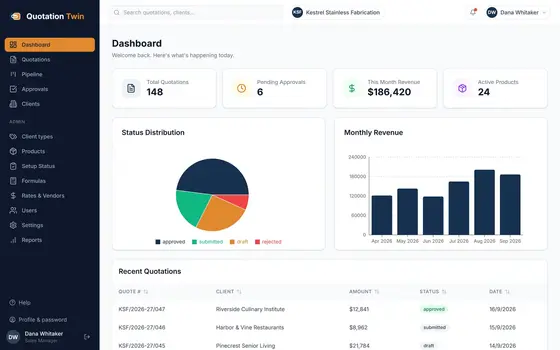
Sazinga Sarva is a platform of business applications for operators — the businesses that run physical assets, field teams, production lines and regulated obligations. Generic CRM and accounting tools handle that work badly because they have no concept of an advertising face, a production batch, an inspection record or a rental period, so the operation ends up held together by a spreadsheet nobody dares change.
Operations
Run assets, bookings and field teams
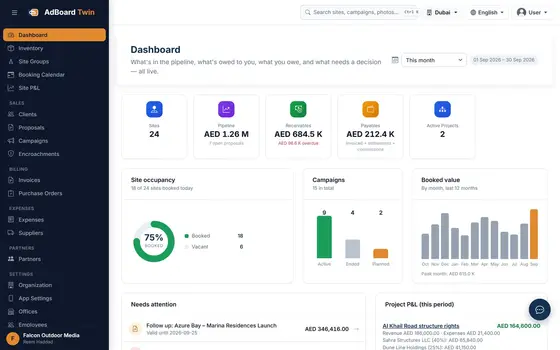
Sazinga AdBoard
Hoarding & Out-of-Home Advertising Management Software
Every site, every booking, every invoice — in one place
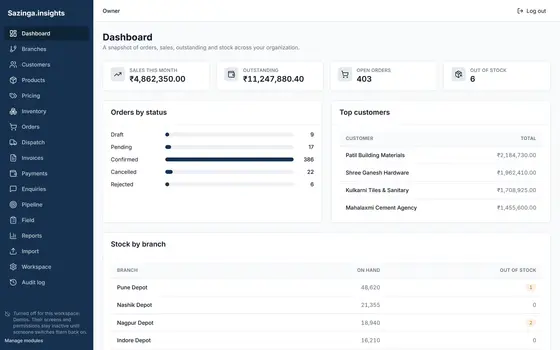
Sazinga Field
Distributor & Field Sales Management Software
Orders, stock, dispatch and the people on the road, in one place
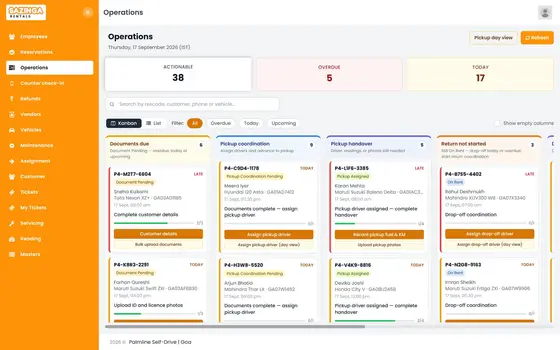
Sazinga Rentals
Rental Management Software
Bookings, availability and the fleet standing behind them
Governance
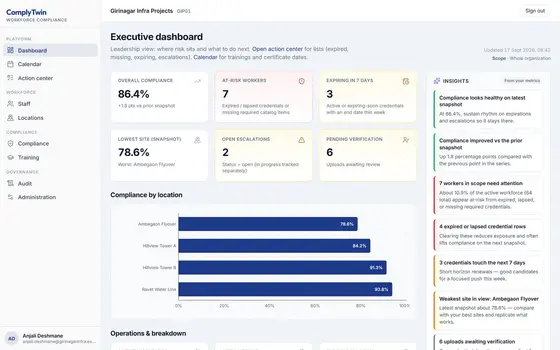
Prove compliance and pass audits
Manufacturing
Make, price and sell what you build
Workforce
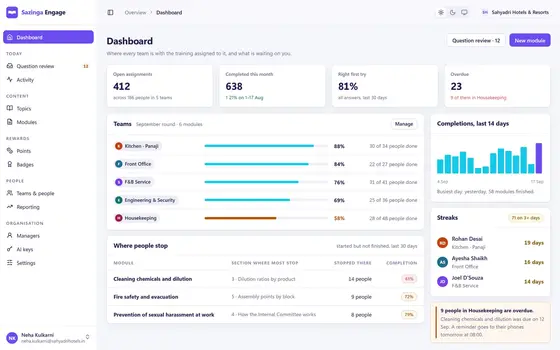
Train and engage your people
Where each application stands today
Seven applications at four different stages. A platform page that implies everything is shipping is the easiest lie in software, so the status below is read from the same record that drives each product page — it cannot say one thing here and another there.
- In production Sazinga AdBoard · Sazinga Comply · Sazinga Field · Sazinga Factory · Sazinga Quote · Sazinga Rentals · Sazinga Engage
- Running with paying operators. Changes ship against real data and a mistake reaches a customer the same day.
Status changes what a conversation about an application is for. A product in production can be demonstrated on real data and quoted for. One in customer trials can be joined as a trial customer, with the trade that you are shaping it and living with what is still moving. One in build or pre-launch is worth talking about only if the timing suits you — we will say which it is rather than let a roadmap read as a price list.
What makes seven applications a platform — and what does not
Three things are genuinely shared, and they are the reason the word platform is used at all.
One team and one set of standards. The same engineers build all seven, so the review discipline, the testing habits and the way permissions, money and offline behaviour are handled do not vary by product.
One way of modelling the work. An asset, a batch, an inspection, a booking and a certificate mean the same things across the applications, which is what makes the joins between them honest rather than an export.
Real domain overlaps. Comply answers whether required training was completed and whether certification is still current, and Engage is what delivers that training and gets people to finish it. Field and Factory cover the sell-side and the make-side of the same operation.
What is not shared is worth stating plainly, because a suite is often sold on the assumption that it is. Each application is its own codebase, with its own deployment, its own API and its own database. There is no single console that runs all seven, and buying two of them is buying two applications rather than one system with two modules. Where they need to exchange data they do it through defined interfaces, the same way they would with a system we did not write.
That is deliberate rather than a gap waiting to be closed. An operator who needs quoting and nothing else should not be made to adopt a compliance module to get it, and a fault in one application should not be able to stop another. The cost of the decision is real — two applications means two logins and two sets of reference data to keep aligned — and it is a cost worth knowing about before you start rather than after.
The combined suite is being brought together and will be offered as a bundle once every application is generally available. Until then, each is priced and deployed on its own, and the honest answer to whether you should buy the platform is that there is no platform to buy yet — only seven applications, four of which are running an operator's business today.
Tell us which part of the operation is costing you most.
7 applications, 7 of them in production. Describe how the work runs where you are — the asset register held in a spreadsheet, the inspections nobody can evidence on the day, the depot stock that disagrees with the van, the quotation that went out at the wrong number — and we will say which one of them fits, whether two of them do, or whether none of them does and what you have is a build.
Thank you — that has reached us
Your enquiry is with the team. We read every one ourselves and normally reply within one working day.
If it is quicker to talk, reach us directly:
While you wait — the platform overview covers what each application does, and Insights is our writing on building this kind of software.
Sazinga Sarva — frequently asked questions
What is Sazinga Sarva?
Sazinga Sarva is a platform of business applications from Sazinga covering advertising operations, compliance and audit, distribution and field sales, batch manufacturing, quoting, rentals, and workplace training. Each application can be used on its own.
Do I have to buy the whole platform?
No. Every application is available standalone today, and each is priced and deployed on its own. The combined suite is being brought together and will be offered as a bundle once every application is generally available.
Do the applications work together?
Yes, and some pair naturally. Comply tracks whether required training was completed and whether certification is current; Engage is what delivers that training and gets it finished. Field and Factory cover the sell-side and make-side of the same operation.
What kind of businesses is Sarva built for?
Mid-market operators who run physical assets, field teams, production or regulated obligations — the work that generic CRM and accounting tools handle badly because they have no concept of a face, a batch, an inspection or a rental period.
Can an application be adapted to how we work?
Yes. The same team that builds the products also runs an engineering practice, so configuration and extension are a normal part of an engagement rather than an exception.
Which Sarva applications are available today?
Four are in production with paying operators: Sazinga AdBoard, Sazinga Comply, Sazinga Field, Sazinga Factory, Sazinga Quote, Sazinga Rentals, Sazinga Engage. Sazinga Field is in customer trials, Sazinga Comply is in build, and Sazinga Engage is pre-launch. Every product page states its own status, and it is read from the same record rather than written by hand.
What makes Sarva a platform rather than seven separate products?
One team, one set of engineering standards, and one consistent way of modelling the things operators actually manage — an asset, a batch, an inspection, a booking, a certificate. What it does not mean is one login, one database or one codebase: each application is built, deployed and run on its own, and buying two of them is buying two applications rather than one system with two modules.