Most organisations have already solved the publishing half of internal training. The safety
induction exists, the compliance refresher exists, the onboarding pack exists. What is missing is
the other half. People open a module, get part way in, and never return, and the reporting records
an assignment where there should be a demonstrated understanding.
Sazinga Engage takes the material an organisation already has and generates comprehension checks
from it, so the questions test the document that was actually issued. Around that sits a reward
loop of points, streaks and visible progress, built for one purpose, which is getting people to the
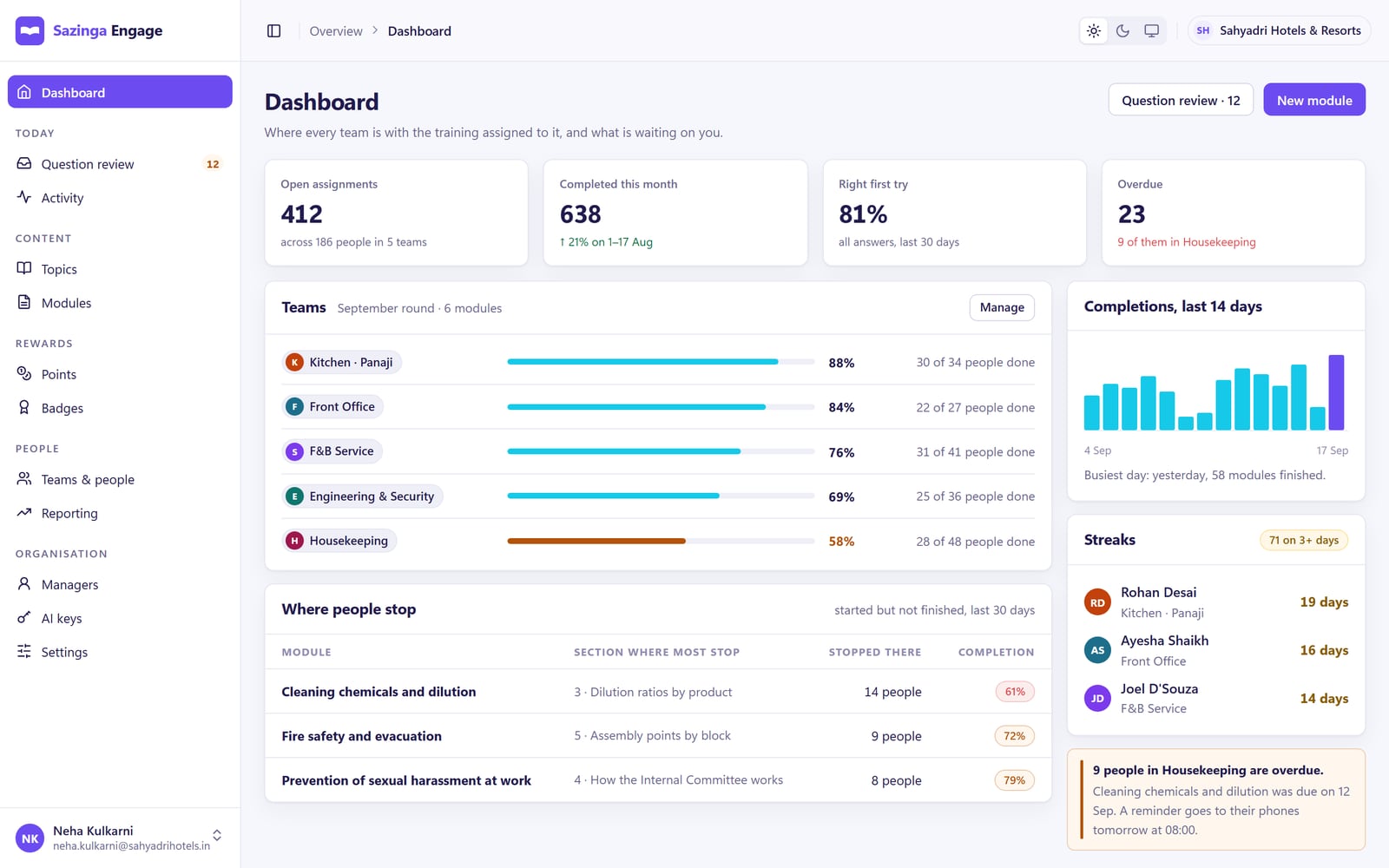
end. Reporting then shows not just who enrolled but where in a module people stopped.
What is available today, and what is not
Engage is in production, deployed white-label. That is the part to be precise about: there is
no public URL to send you to and no client we can name, because the deployments carry somebody
else’s branding rather than ours. There is also no sign-up page, no published price list and no
self-serve trial — a walkthrough on a demonstration tenant is how you see it.
The engine underneath is not new. The generation pipeline, the quiz model and the reward loop run
in a consumer learning application built on the same stack — a FastAPI and PostgreSQL server with
a React Native client — which is where the mechanisms described below come from. The workplace
product is that engine given an organisation, roles, assignment by team, and reporting a manager
can act on.
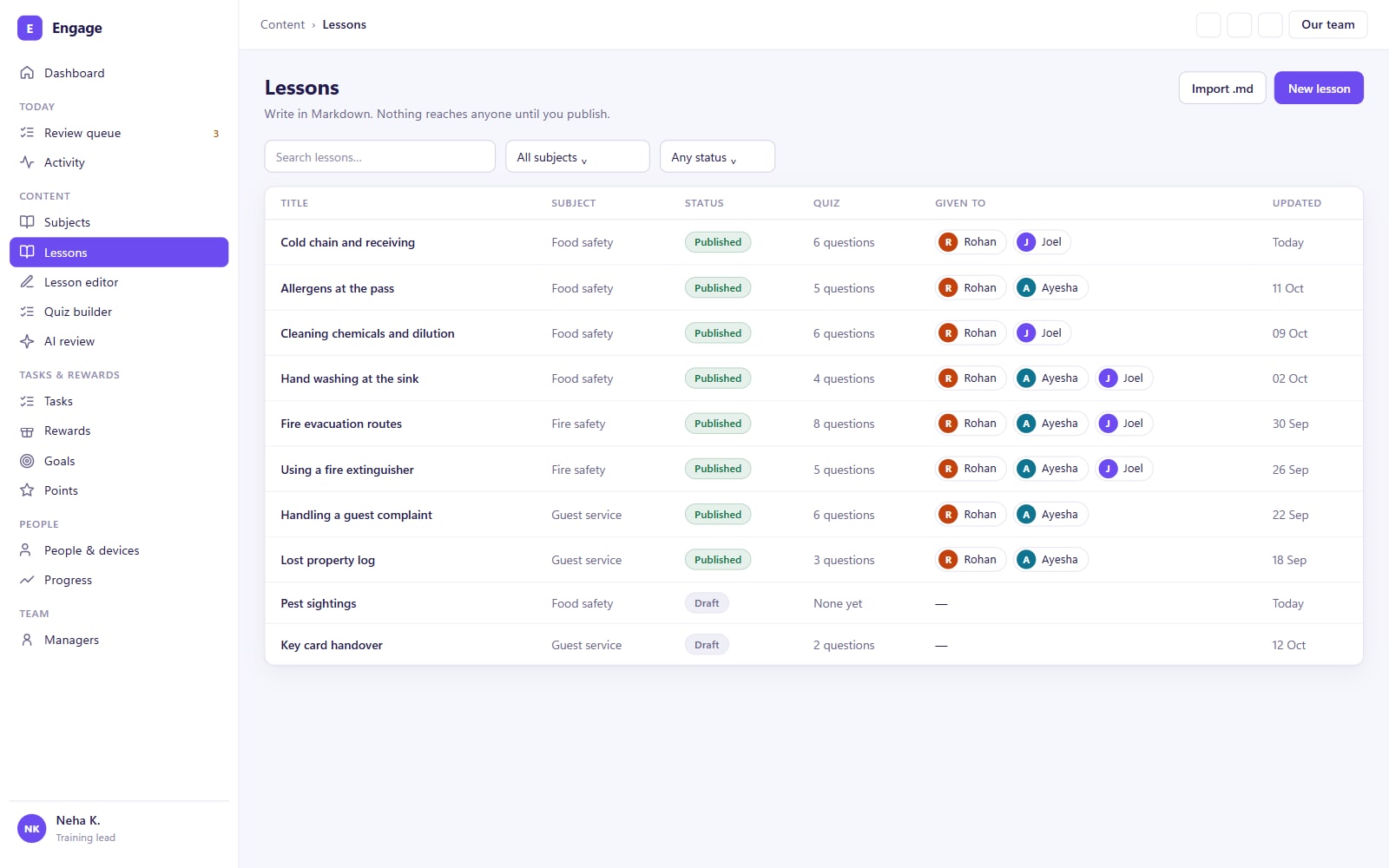
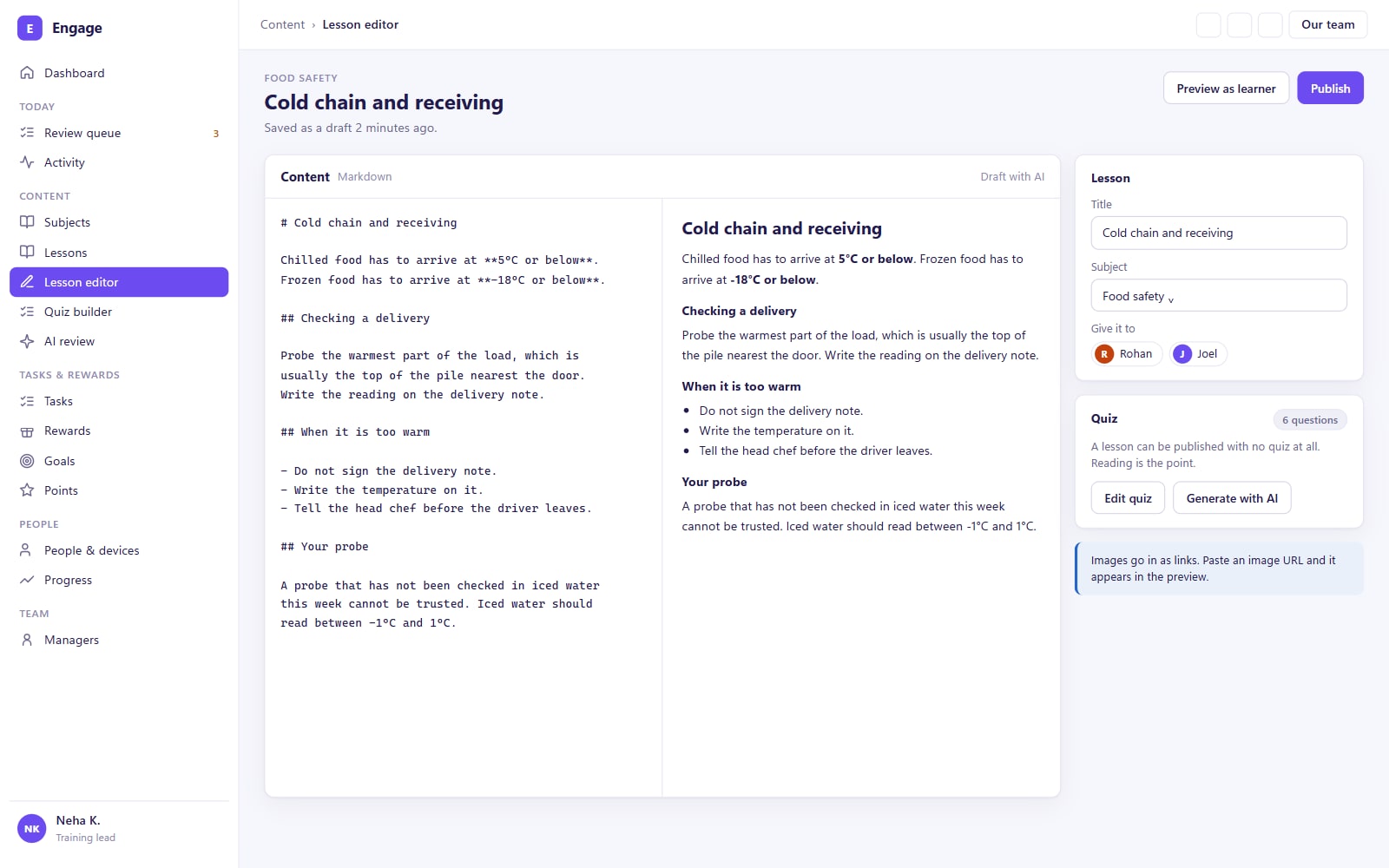
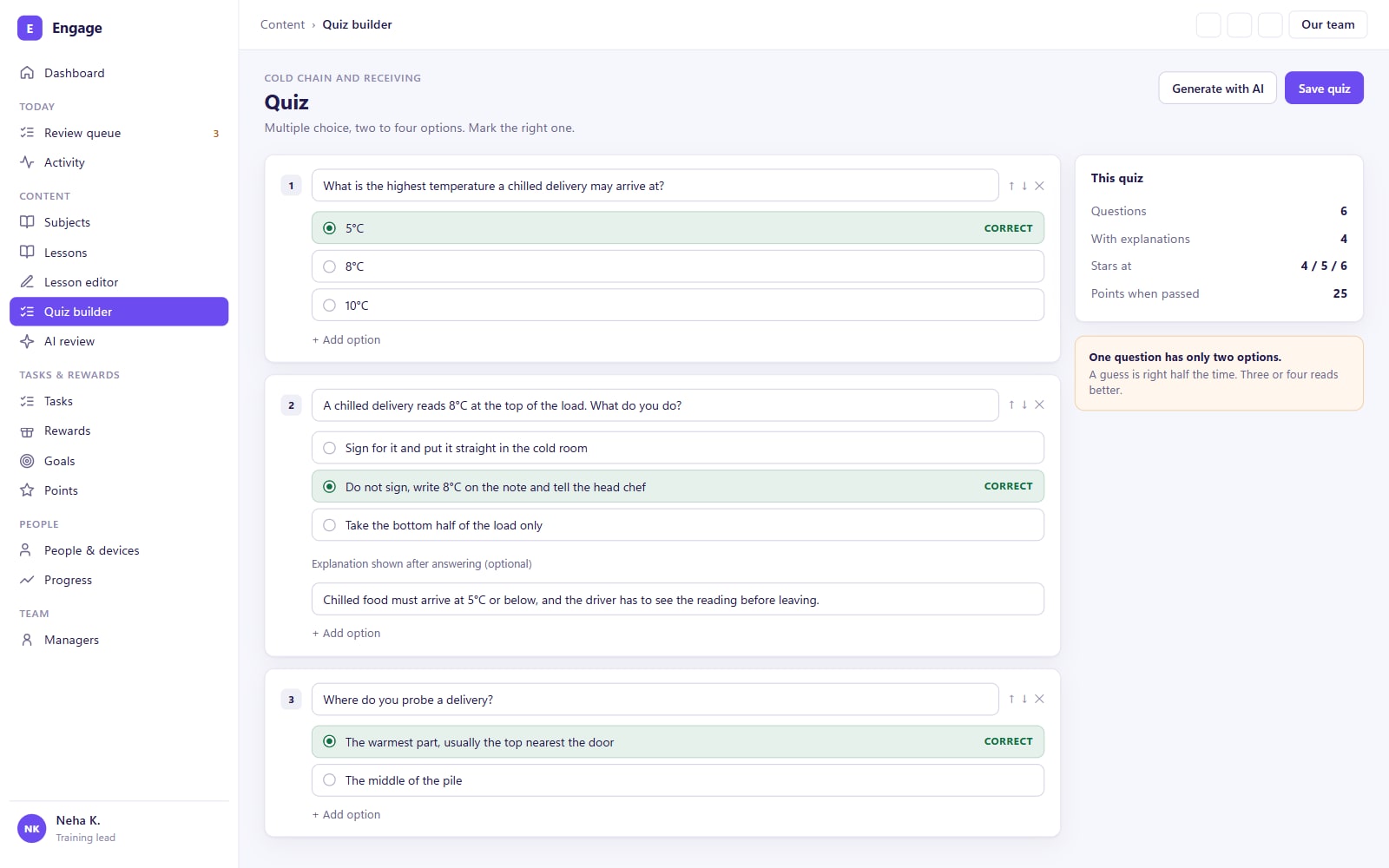
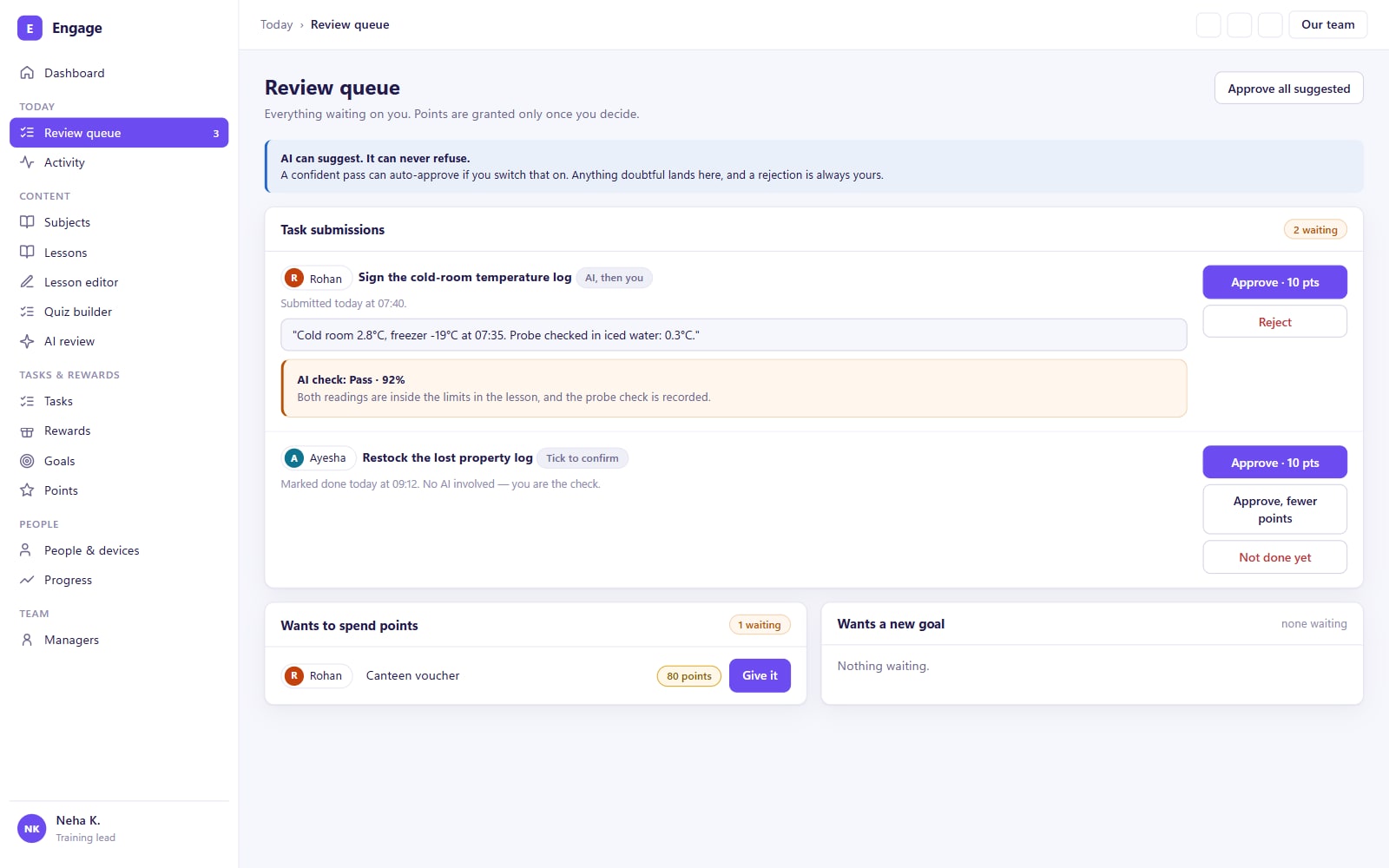
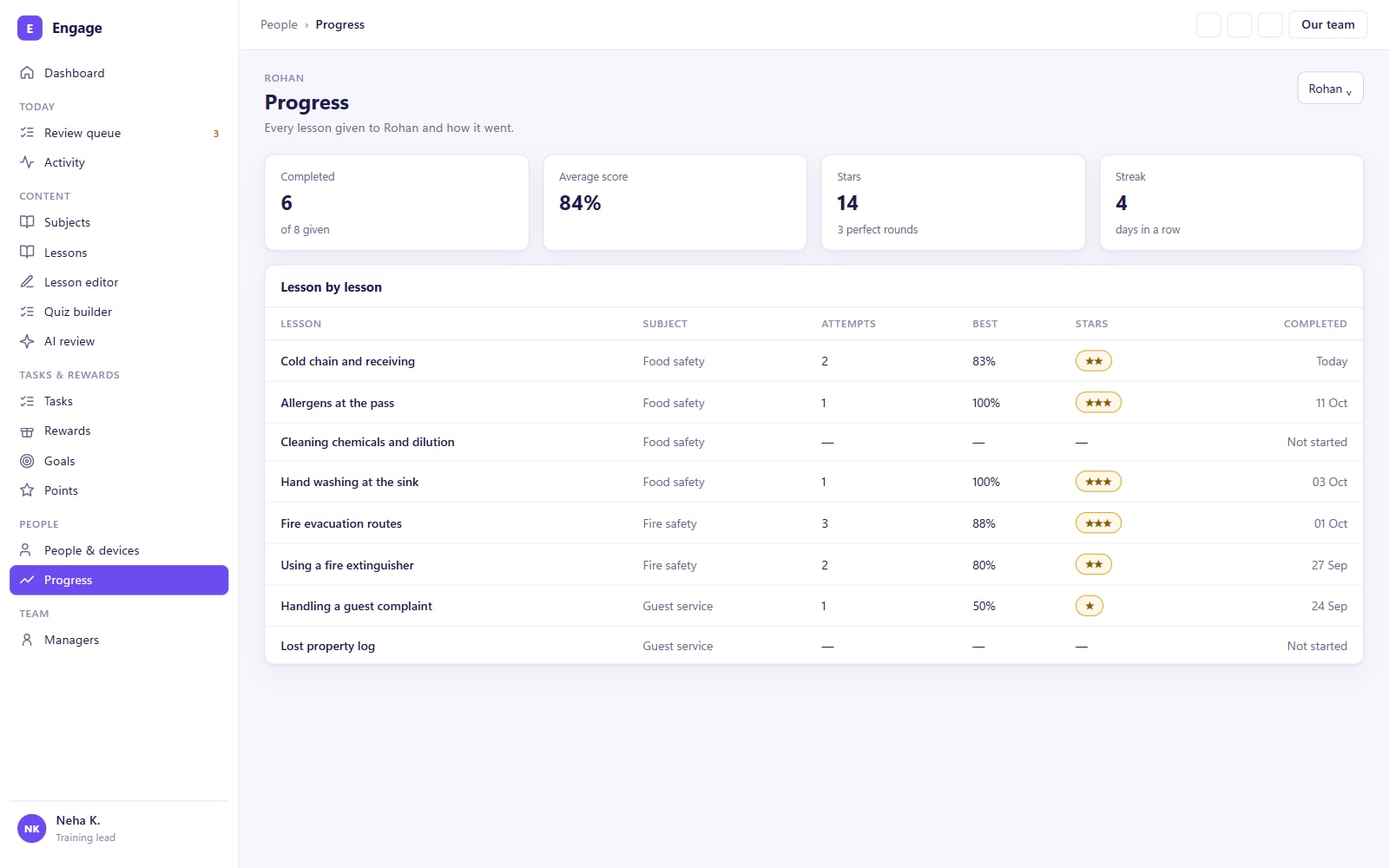
One consequence worth stating, because it is visible on this page: the screens below are captures
of that consumer application with the labels changed, not of a live Engage tenant, and each says so
underneath it. White-label deployment is exactly why we cannot publish the real ones.
Why questions generated from your own material behave differently
A generic question bank tests the topic. A question generated from the document you issued tests
the document you issued. That distinction is the reason to do the harder thing, and it changes
what a pass means: answering correctly demonstrates having read your safety brief, not general
familiarity with safety.
Photographs of printed material work as an input, which matters more than it sounds — most
organisations’ real training content is a laminated procedure on a wall or a page in a binder, not
a tidy PDF. Images are downscaled and re-encoded on the device before they are sent anywhere,
which is not a bandwidth optimisation but a privacy step: re-encoding drops the EXIF block, and
that block contains the coordinates of the room the photograph was taken in. A file already small
enough is re-encoded anyway, because skipping that pass to save work would switch location
stripping off for precisely the pictures taken closest to home.
How the generation is made reliable rather than lucky
Language models fail intermittently, and a training platform that shrugs at a failed generation
puts the work back on the person who was trying to publish. Three mechanisms, all measured rather
than assumed.
The request carries a real response schema rather than an instruction to return JSON. Asking a
model for JSON guarantees only that the reply parses — an empty object is valid JSON and a useless
answer, and it fails a layer later as a confusing parse error rather than as a bad generation.
Failures are classified before they are retried. An unusable reply gets up to three further
attempts against the same credential, with the sampling temperature nudged so the model genuinely
re-rolls rather than returning the same thing. A rate limit, a rejected credential or a network
error moves straight on to the next provider, because repeating those changes nothing.
Every attempt is recorded — provider, model, number of attempts, duration and outcome — so the
question “is generation working” is answered from a table rather than from an impression. That
record is also what a usage allowance is counted from.
The detail that decides whether a quiz is any good
The position of the correct answer. A set of questions written by hand, or generated one at a
time, drifts towards putting the right answer in the same place, and learners find that pattern
long before they find the material. Engage places correct answers by a generated rotation across
the option positions rather than leaving it to whoever wrote the question — an approach that came
directly from
a batch of 150 questions where every answer was option one.
Why publishing is a separate act
A quiz is created as a draft and stays invisible to learners until it is explicitly published. A
learner’s device only ever offers published material and refuses an attempt against anything else.
This is deliberate friction. The alternative — content that goes live the moment it is saved —
means half-written questions reach people, and the correction arrives after they have answered
them. The cost of the separation is that a module can be published with no quiz attached, so
publishing warns when it would leave a learner with material and nothing to answer.
What the reward loop is actually made of
Points earned per correct answer, a streak counted in consecutive active days, badges, and per-item
progress that lets someone continue where they stopped. The learner-facing loop — read, answer,
see the reward — runs entirely on the device and touches the network zero times; synchronisation
happens in the background afterwards.
Two kinds of record sit behind it, on purpose. Progress is stored per item, and the aggregate
counters are stored separately. A lost counter update costs a number that can be recomputed from
the per-item records; it never costs the history of what somebody actually completed.
What it does not do
It does not author your training. It generates comprehension checks from material you supply, and
somebody in your organisation still has to review them before they go out — the review step is
part of the design, not an oversight.
It is not a compliance register. It records that a module was completed and when; it does not track
the certificate that results, its expiry, or the obligation that required it. That is
Sazinga Comply, and the two are being built to meet at the point where a
completion becomes evidence.
It also does not do video hosting, live sessions, SCORM import or accredited course delivery, and
it is not a substitute for training that legally requires an assessor in the room.
Where to go next
The sectors this is aimed at first are the ones where training is issued, evidenced and audited
rather than merely offered: food safety,
construction and healthcare. If your
immediate problem is proving that certification is current rather than that people understood the
material, start with Sazinga Comply instead — and note that it is also still in
build.