
Procurement and raw material
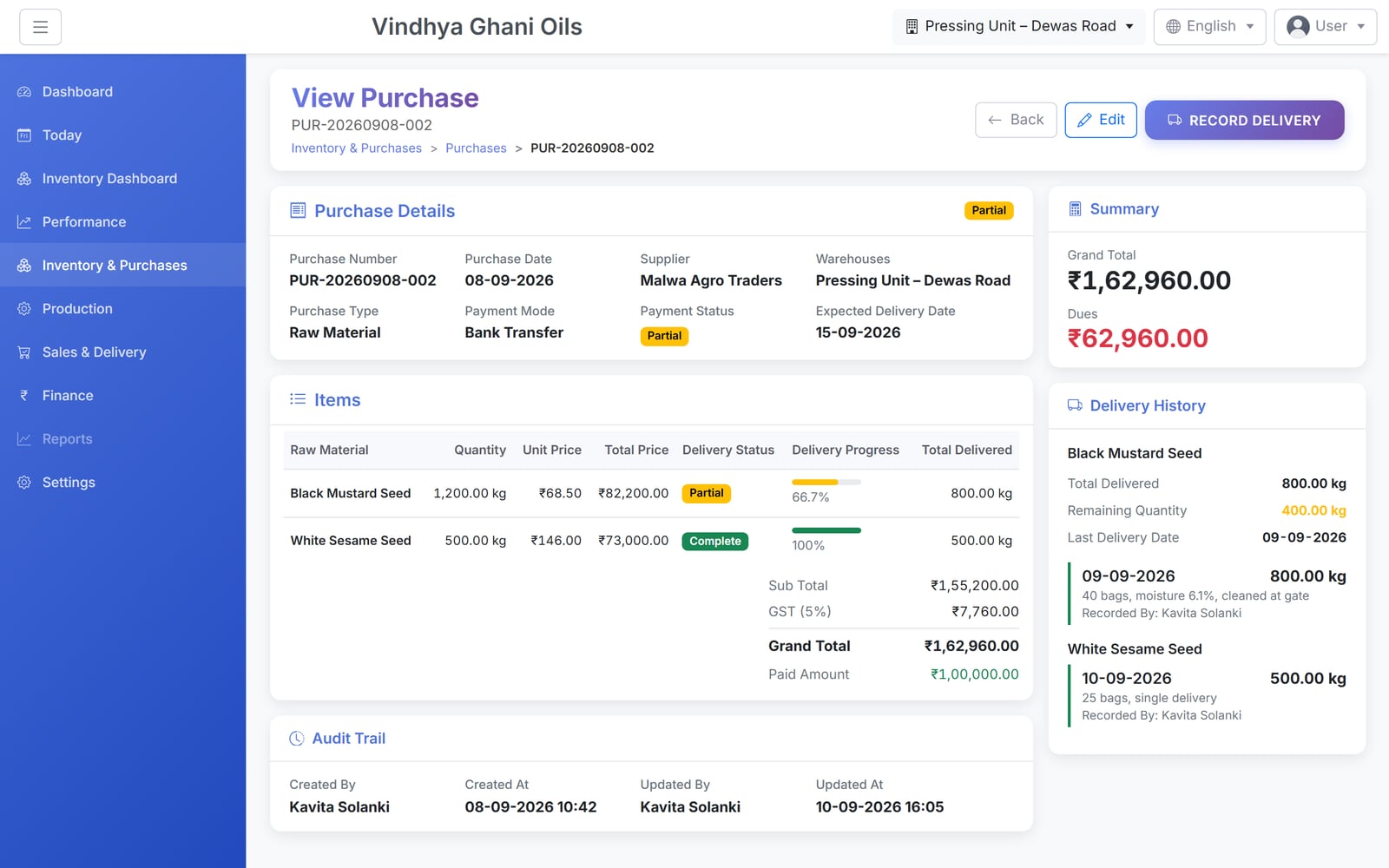
Purchase orders, goods received and supplier records, with raw material entering stock against the lot it arrived in. What was bought, at what rate, and what remains of it are answered from the same record.
Sazinga Sarva · Manufacturing
From raw material to finished batch, with the yield accounted for
Batch manufacturers who buy raw material, produce in runs and need to trace what went into each output
In production — Running in cold-press oil manufacturing; the batch model applies to food processing and similar batch industries.

Every screen below is rebuilt from Factory's own interface and filled with a demonstration tenant's data. They are not captures of a live customer system.
Tap any picture to open it full size.
You get something made from your own material, within one working day, and no call unless you ask for one.
The sheet you fill in for one production batch, from raw material in to product out. Within one working day we return the yield it shows and the traceability view it would produce.
Your enquiry is with the team. We read every one ourselves and normally reply within one working day.
If it is quicker to talk, reach us directly:
While you wait — the platform overview covers what each application does, and Insights is our writing on building this kind of software.
Would rather read than write? See the screens above, or the whole platform — seven applications, each one standing on its own.
Batch manufacturing tends to get measured after the fact. Raw material is bought on one sheet, production noted in a floor register, finished stock counted at month end, and yield calculated later from figures that no longer agree. By the time a run is known to have underperformed, the material is gone and the reason is a matter of memory.
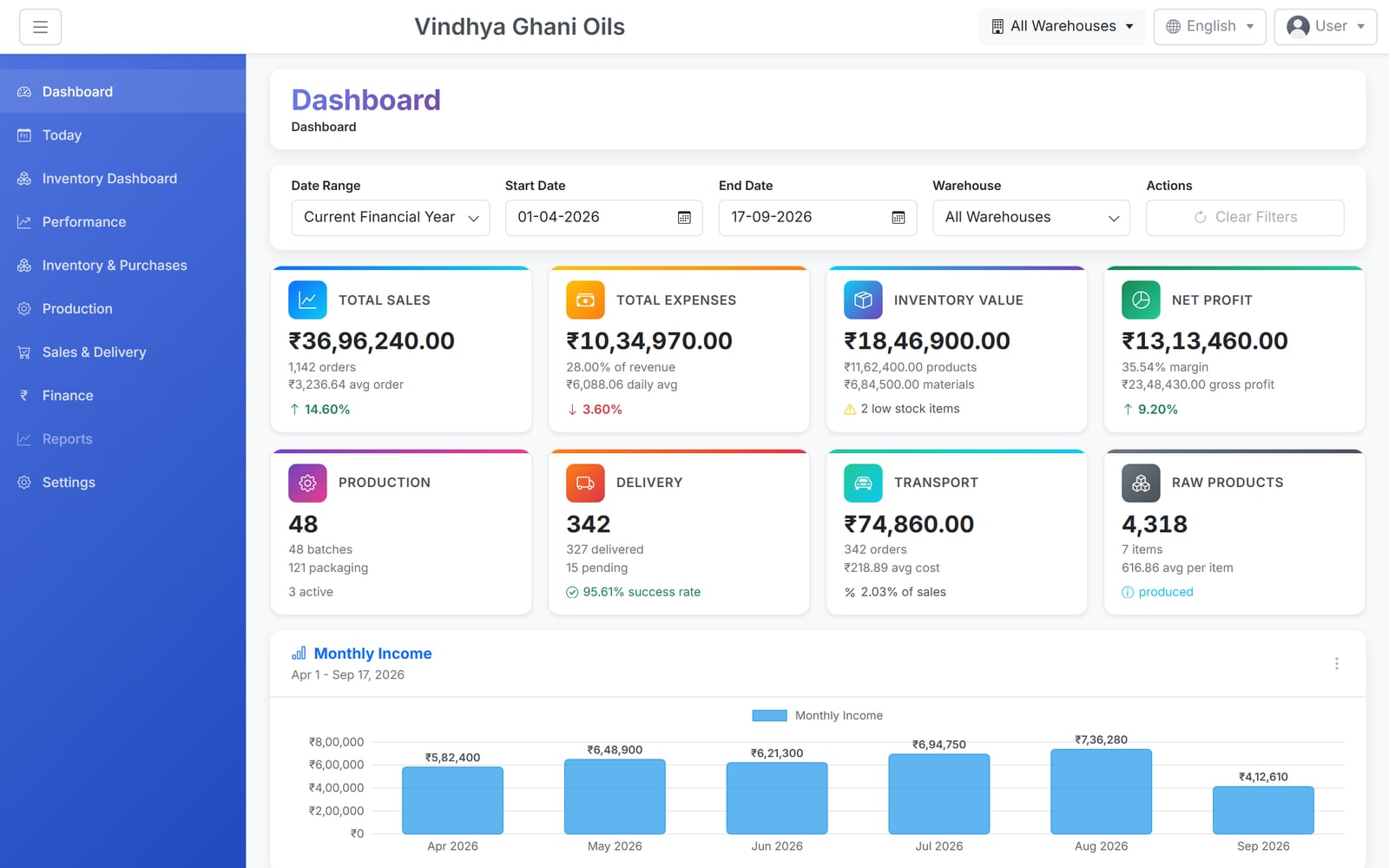
Sazinga Factory records the run as it happens. Each batch carries the lots it consumed, the outputs it produced and its expected yield against actual, and every finished unit traces back to its inputs and forward to the dispatch it left on. Counter sales through the built-in point of sale draw on the same inventory as production, so there is one stock figure rather than two.
A purchase register, a production diary on the floor, a stock sheet in the office, and a monthly reconciliation that exists to make the three agree. The reconciliation is the tell: it is a recurring task whose entire purpose is to repair a data model.
Most manufacturing software offers you a bill of materials and a work order. Batch processing does not fit that shape, because what comes out of a run is not a fixed quantity of one thing — it is a variable quantity of a main product and a by-product, and how much of each depends on the material that went in that day.
Factory models it as raw material, intermediate product, and finished packaged product, with a separate stage between each.
The separation matters because losses happen at different stages for different reasons, and a model that collapses them into one step cannot tell you which stage you are losing at.
Expected yield is not typed in per batch and it is not a rule of thumb held by the supervisor. Each raw-material-to-intermediate-product pairing carries a conversion efficiency percentage, with one pairing marked as primary. That number is the plant’s stated expectation, held in one place and edited deliberately.
Actual yield is the sum of what the runs produced against the sum of what they consumed. Expected against actual is therefore a comparison between a figure that was fixed before the run and one that emerged from it — which is the only version of that comparison worth having. A yield figure computed after the event from a target that was adjusted after the event proves nothing.
Every movement of every item goes through one function. There is no second path.
That function does three things inside a single database transaction: it refuses an outward movement that exceeds what is available, rejecting it with a conflict rather than allowing stock to go negative; it writes an immutable movement row; and it applies the change to the balance the screens read. The movement row carries the item type — raw material, intermediate product, finished product or packaging material — the direction, the quantity, the warehouse, the person, the time, a reason code, and a reference to the record that caused it.
The reason codes are the useful part. A movement is not just an adjustment of minus 400 kilograms; it is a batch input, a press-run output, a packaging consumption or an explicit manual adjustment, each pointing at the batch, run or packaging entry it belongs to. Stock that disagrees with the floor is therefore a question with an answer, because the balance can be rebuilt from the movements that produced it.
Having exactly one write path is the whole point. Where several routes update a stock column directly, they diverge — and they diverge quietly, which is worse.
Two directions, both answered by following the same chain rather than by a separate traceability module.
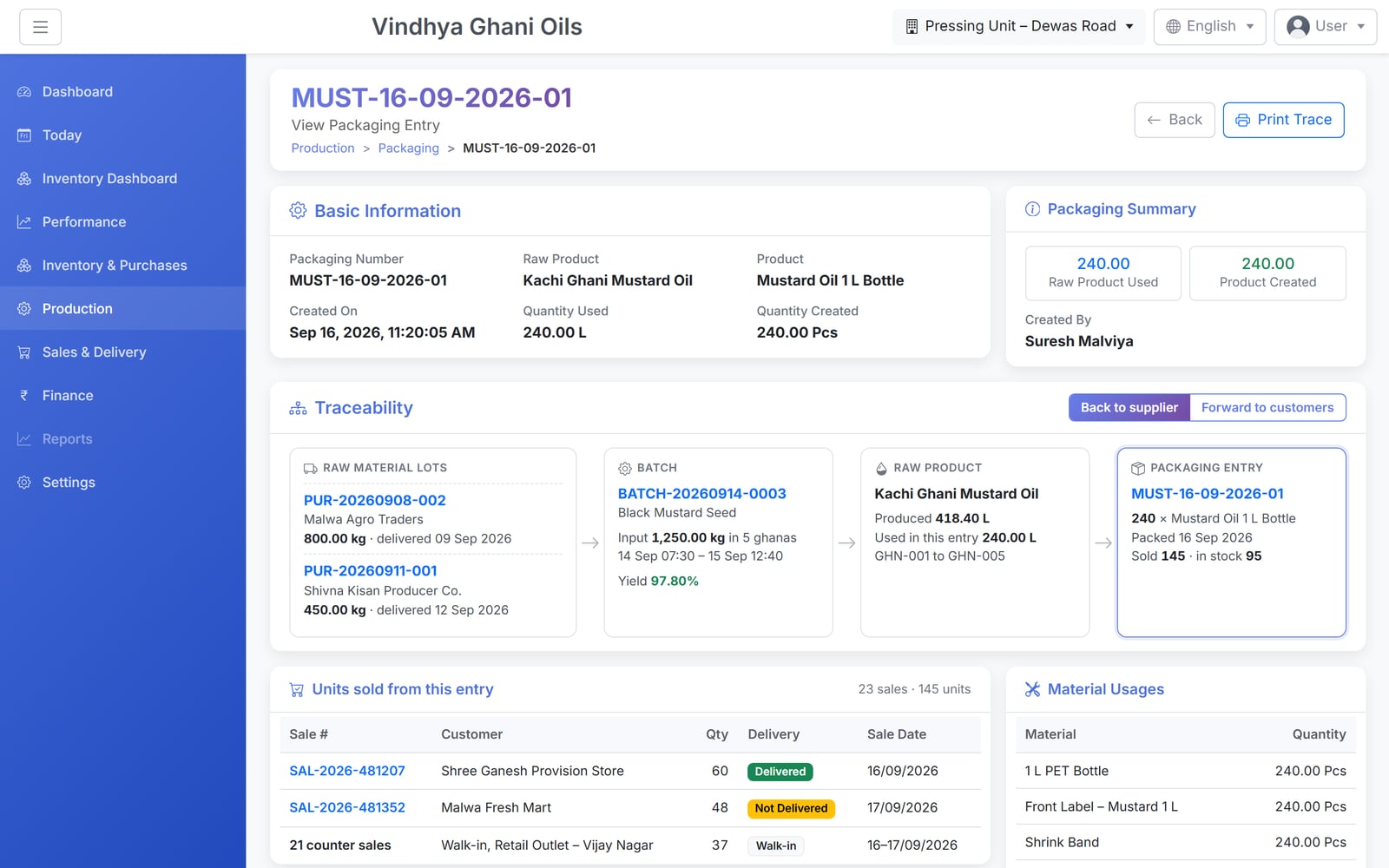
Backwards, from a finished unit: the packaging entry names the intermediate product and quantity it consumed; the runs that produced that intermediate product name the batch they belonged to; and the batch names the raw material and the warehouse it was drawn from. Forwards, from a raw material receipt: the same chain read the other way, out to the packaging entries and then to the sales the finished units left on.
The practical test is a recall. Somebody rings on a Friday afternoon with a batch code from a label, and the question is which raw material went into it and where else that material ended up. That is a query here, not a fortnight with the registers.
Purchases record what was ordered, and deliveries against that purchase are recorded separately, so a part delivery is a part delivery rather than a purchase you have to split or overstate. Raw material enters stock as a movement against the delivery that brought it.
Each warehouse is a stock location in its own right, users are scoped to the warehouses they work in, and every table carries the organisation that owns the row — so a group running several units runs them in one installation without their stock, batches or customers meeting.
It is not a discrete-manufacturing MRP. There is no multi-level bill of materials with sub-assemblies, no routing through work centres, no machine scheduling and no capacity planning. If you assemble a product from a tree of components, this is the wrong shape and you should be looking at MRP rather than at batch software.
There is no laboratory information system either: quality results are notes and attachments against a batch rather than a parameter-by-parameter specification with automatic hold and release. And it does not price bespoke made-to-order work — a product priced from dimensions and options each time belongs in Sazinga Quote.
Factory is the make side; Sazinga Field is the sell side, covering dealers, distributors, dispatch and receivables once the finished goods exist. The distribution industry page covers where the two meet, and the distributor network case study covers one estate that runs both halves.
Swipe for the other screens.


Purchase orders, goods received and supplier records, with raw material entering stock against the lot it arrived in. What was bought, at what rate, and what remains of it are answered from the same record.
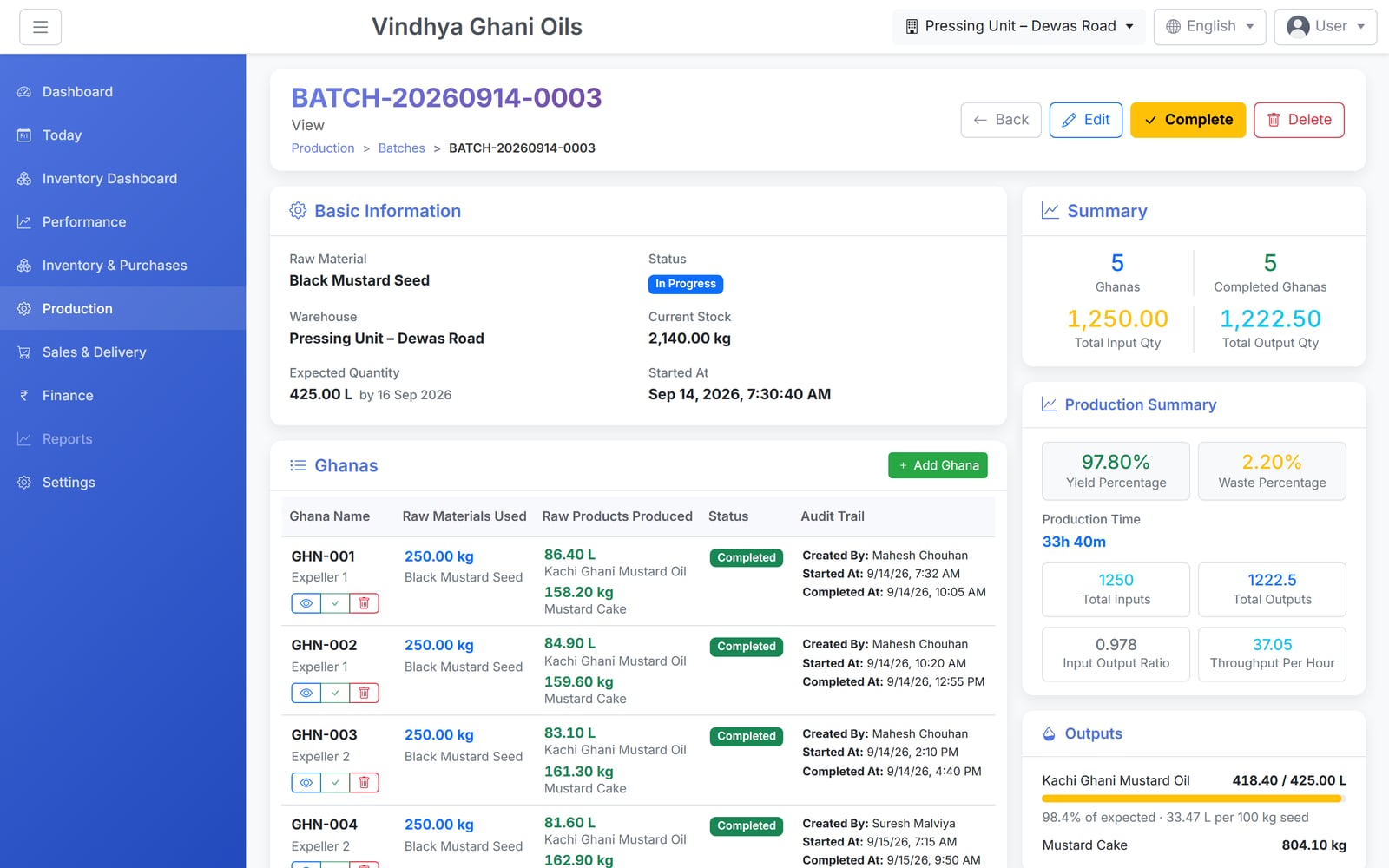
Each production run is a batch with its inputs, its outputs and its by-products. Expected yield against actual yield is recorded per batch, so a run that produced less than it should have is visible while it still matters.
Every finished unit traces back through its batch to the raw material lots that went into it, and forward to the dispatch it left on. A recall question is answered by lookup rather than by reconstruction.
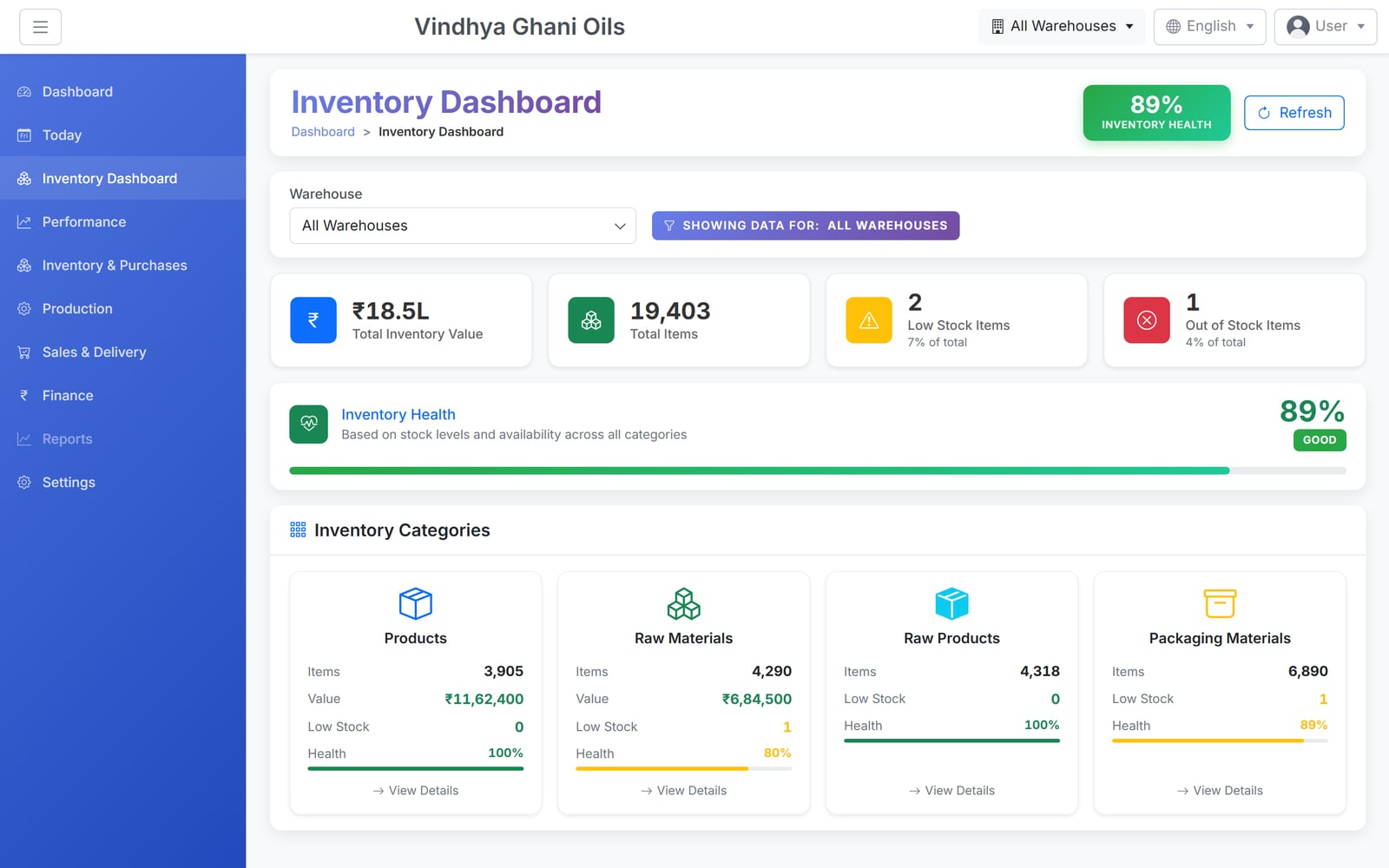
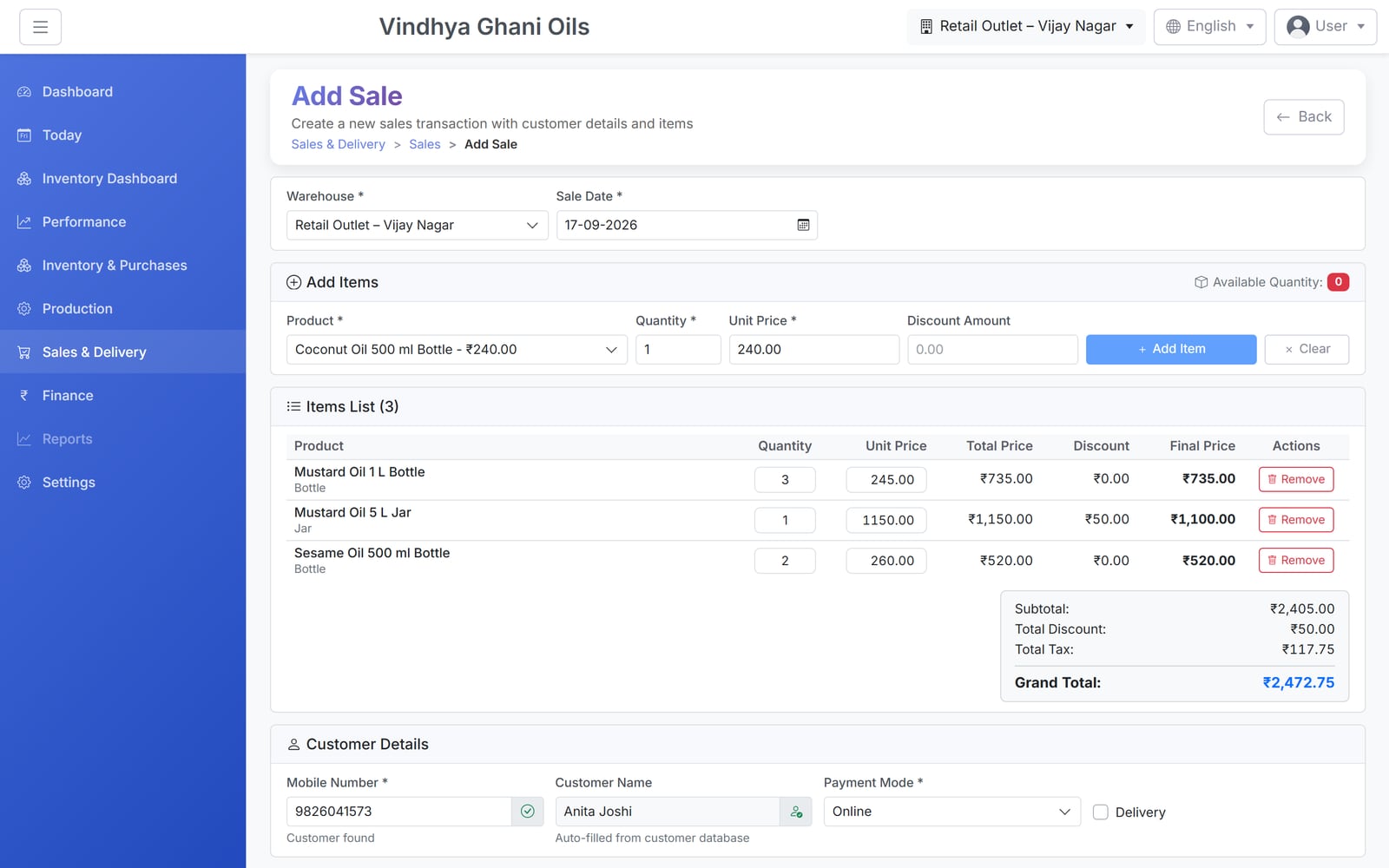
Live stock across raw material, work in progress and finished goods, with a retail point of sale for counter sales that decrements the same inventory the production side writes to.
Each of these is a real problem from a live installation, what it cost, and what changed.
Sazinga Factory is batch manufacturing software covering procurement, production, inventory, sales and delivery. It records each production run as a batch with its inputs, outputs and yield, traces finished goods back to raw material lots, and includes a point of sale for counter sales.
Factory is the make side and Field is the sell side. Factory covers buying raw material, running production batches, yield, traceability and stock. Field covers dealers and distributors, field sales teams, orders, dispatch and receivables. They address different halves of a business rather than competing for the same one.
Any manufacturer producing in runs rather than continuously that needs to know what went into each run. It is in production in cold-press oil manufacturing and applies to food processing, spices, cosmetics and similar batch industries.
Raw material is received against a lot. A production batch records the lots consumed and the outputs produced. Finished goods carry their batch, and dispatches record which batch left on which delivery, so a lot traces forward to customers and a finished unit traces back to its inputs.
Yes. A point of sale is built in for counter sales at a factory outlet or shop. Sales through it decrement the same finished goods inventory that production writes to, so shop stock and factory stock are never two separate figures.
Yes. The interface ships in English and Hindi, so production floor users and office users can each work in the language they read most comfortably within the same installation.