
Commercial Kitchens
CPQ Software for Commercial Kitchen Fabricators
Every worktop, sink unit and canopy is made to size, so each enquiry means rebuilding a pricing spreadsheet by hand and hoping the steel weight was right.
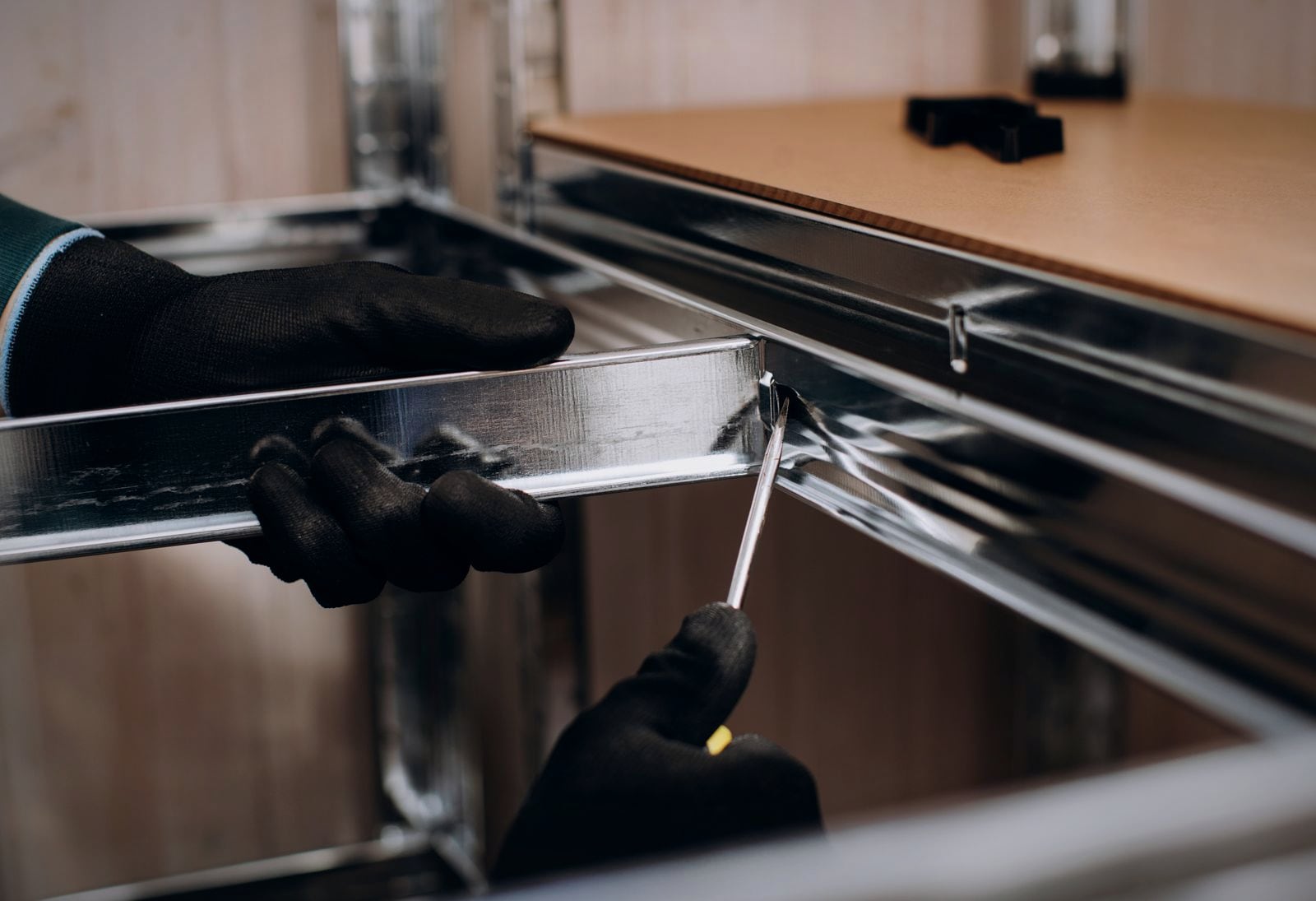
Commercial kitchen fabrication is a made-to-order business dressed up as a product one. Nothing is standard: a worktop is priced by its length, depth, upstand and grade, and the same item can be quoted a dozen ways in a week depending on which estimator picked it up.
The cost of that is quiet. Quotes take a day to turn round, margin varies between estimators, and the drawing the client approved and the specification the workshop receives are often two different documents that drifted apart somewhere in between.
Why nothing in a commercial kitchen is a standard size
A catalogue implies interchangeable units. A kitchen is a room with pillars in it, a floor that falls towards a gully, a door the equipment has to pass through, and services already stubbed out where the last contractor left them. Every work table, sink unit, dish landing table, pick-up counter and exhaust canopy is cut to fit that room.
So the sellable item is a specification rather than a product code: length, depth, working height, upstand height, gauge, grade, undershelf or not, plain or tray-type top, bowl count and bowl dimensions, drain board side, feet or castors, and the finish. Change any one and the price changes, because the arithmetic underneath it changes.
The structure that makes this manageable is to treat an item as a set of feature groups rather than as a product. A counter has a top configuration, a base structure and an under structure, and it may have a splash back, an overhead shelf, a covering, a drawer type and any number of accessories. Some of those groups are mandatory and single-choice; accessories are optional and multiple. Each choice carries its own rule and its own dimensions — burner count, bowl length and breadth, glass height, partition quantity — so a pav bhaji counter and a plain work table are the same machinery configured differently rather than two products to maintain.
Grade is not a label on that specification either. SS 304 is the general-purpose austenitic grade and is what food-contact surfaces should be made of; SS 202 substitutes manganese for most of the nickel, is materially cheaper and is genuinely less resistant to chlorides, which makes it fine on a dry-store rack or a leg frame and a poor choice on a wet bench or near a dishwash area. SS 316 adds molybdenum for chloride resistance and belongs on coastal sites and heavy chemical wash areas. The price spread across those three grades on an otherwise identical table is around 90 per cent, so the grade question is a commercial one and not a specification detail.
What a site survey actually has to capture
The survey is where the money is made or lost, because everything priced afterwards inherits it. What has to come back from site, in numbers rather than impressions:
- Clear wall-to-wall dimensions at working height, not at floor level, and the out-of-square
- Ceiling height under any beam or duct the canopy has to sit below
- Access route dimensions — door widths, lift car, stair turns — which decide what can be built in one piece and what has to be split and joined on site
- Service positions: gas points, water inlets and drain gully locations, power points and their ratings, and which of them are already where the layout assumes
- Floor finish and coving detail, and whether plinths or adjustable feet are being used
- Extract requirements around the cooking suite, and where the ductwork can actually run
A survey that returns a sketch and a promise produces a quotation that is a guess, and the variation that follows is argued about after the equipment is already fabricated.
How the enquiry arrives, and why that shapes the quote
Rarely as a clean brief. It arrives as a kitchen consultant’s equipment schedule, a main contractor’s BOQ line, a marked-up layout drawing, or a photograph of a hand-written list. The item descriptions use the client’s vocabulary rather than yours, quantities are sometimes per unit and sometimes per run, and the deadline is the same day either way.
That is why pricing has to be computed from a small number of inputs rather than assembled from a catalogue. If an estimator has to find or create a product record before a price exists, the answer arrives after the enquiry has gone cold. If the price is a function of dimensions, grade, gauge and options, any line on any schedule can be priced as fast as it can be read.
Fabrication drawings, incidentally, are not the specification. They are usually stamped not to scale and they carry only the dimensions somebody thought to write on them, which is much less than the quotation already knows.
What usually breaks first
Consistency, and then traceability.
Two estimators price a comparable counter and arrive at different numbers, because each is working from a spreadsheet that has been copied and locally adjusted for years — a wastage percentage nudged for a difficult job and never nudged back, a labour rate updated in one file and not another. Nobody can reconstruct afterwards which assumptions produced which price.
Then a revision arrives. The client moves a bowl, changes a top from plain to tray-type, adds two metres of wall shelf. The quotation is re-sent as a new attachment, the old one is still in somebody’s inbox, and at delivery there are two documents in circulation and no record of which was approved or by whom.
What the client needs to see before they commit
A line on a schedule that reads “SS work table with undershelf, 1800 × 750 × 850” is agreed by people who are each picturing something slightly different. Bowl position, upstand height and the side the drain board sits on are exactly the details that get discovered on delivery day.
A preview generated from the same dimensions that produced the price closes that gap without costing drawing time, because it is built from the pricing inputs rather than modelled separately. The client confirms the shape before anybody cuts, and a specification error becomes a quoting correction rather than a rework.
The commercial equivalent is the quote itself being a record rather than a file. A link that always shows the current revision, with the previous total, the added and removed items and the new total visible, removes the argument about which version was agreed.
What the workshop needs to receive
The same figures that were priced, not a retyped order. An accepted quotation already knows which material each part is in, at what grade and gauge, how much of it, and the blank size including the turn-down — because it needed all of that to produce the number.
That gives the buy list and the cutting list without anybody doing the arithmetic twice. It matters more than it sounds: an estimator who allowed two inches all round for the fold and a cutter who allows an inch and a half are both being reasonable, and across forty lines the difference becomes material variance nobody can explain.
When this is not the right fit
If you mainly resell imported cooking equipment — ranges, combi ovens, dishwashers — and fabricate only the occasional table around it, this is a catalogue business and catalogue software will serve it better. Shops that genuinely do both usually want both kinds of tool rather than one stretched to cover the other.
If you are a single-person shop quoting a handful of jobs a month from memory, a spreadsheet is cheaper and faster, and it will stay that way until a second person starts quoting.
And this is a quoting and specification tool, not a kitchen design package. It does not produce a CAD layout, a ventilation calculation or an equipment schedule for a consultant. If what you need is the design itself rather than the price and the specification behind it, that is a different category of software.
What changes
- Price calculated from dimensions, gauge and grade rather than looked up in a spreadsheet
- Parametric 3D preview built from the same measurements the price came from
- Quotes shared as a link the client can open, with revisions tracked against the original
- Branded PDF for the client and an Excel export with the specification for the workshop
The application
Sazinga Quote
The pricing formula, out of the spreadsheet and under control
Price bespoke, made-to-order manufacturing from governed formulas, with parametric 3D preview, shareable quote links and branded PDF output.
Problems we have already met in Commercial Kitchens
- Responsive table not working on mobile? Ours hid half Our quotation table showed four of eight columns on a phone and the usual check passed. How to spot a table that is not responsive on mobile, and how we fixed it.
- Soft 404 errors: sending broken links to the homepage Sending every broken link to the homepage creates soft 404s: endless identical pages that look real. The cause, how to check your site, and the one-line fix.
- Uptime monitoring: a security update took our system down A server security update broke a quoting system and no alert fired. How to find out first: what to ask your supplier to check after any security change.
- Cutting list software: from quotation, no retyping Can a quote produce the cutting list and bill of materials without retyping the job? Yes, if it keeps its working. What you get, and what it cannot do.
Is this how it works where you are?
Every worktop, sink unit and canopy is made to size, so each enquiry means rebuilding a pricing spreadsheet by hand and hoping the steel weight was right. That is the pattern this page starts from. Tell us how it actually runs in your operation — the spreadsheet, the photographs on somebody's phone, the register in the site office — and we will say plainly whether Sazinga Quote fits it or whether it is a build.
Thank you — that has reached us
Your enquiry is with the team. We read every one ourselves and normally reply within one working day.
If it is quicker to talk, reach us directly:
While you wait — the platform overview covers what each application does, and Insights is our writing on building this kind of software.
Commercial Kitchens — frequently asked questions
What software do commercial kitchen fabricators use for quoting?
Fabricators need formula-driven pricing that takes length, depth, upstand height, gauge and steel grade and returns a price, not a catalogue of fixed products. Sazinga Quote prices each item from its dimensions, previews it in 3D and produces a client quote and a workshop specification from the same input.
How does it price a bespoke item that is not in a catalogue?
Each product type is configured once as a formula — sheet area and grade give material cost, then fabrication, welding, polishing, fittings and finish are added as rules. Any set of dimensions within the allowed range then prices itself, including the offcut allowance you set.
Can the client see what they are buying before they commit?
Yes. The quote link shows a 3D model generated from the entered dimensions, so a client can see bowl positions, undershelves and upstands before approving. Changing a dimension updates both the model and the price on the same screen.
What does the workshop get from the quote?
An accepted quote carries its full specification through — dimensions, grade, gauge, bowl sizes, fittings and finish — exported to Excel or PDF, so the shop floor works from the figures that were priced rather than a re-typed order.