
The words this trade uses
Several of them mean the same thing, which makes comparing two products harder than it should be. These are the definitions Comply is built on, and where it takes a position, it says so.
Jump to
- Obligation
- A recurring duty an organisation carries — an inspection, a check, a renewal, a filing. It has a source it comes from, a frequency, an owner, and a defined artefact that closes it. An obligation nobody owns is the one that lapses, which is why the owner is part of the record rather than a convention.
- Obligations register
- The single list of every obligation the organisation carries, with what is due, what is overdue and what is unassigned. The word register matters — it is a ledger rather than a task list, so an obligation that has been met still exists, with its history attached.
- Evidence
- The thing that proves an obligation was met — a certificate, a photograph, a signed checklist, a test result. An obligation closed without evidence is an assertion. In an audit, the difference between the two is the entire conversation.
- Verification
- A named person confirming that a piece of evidence is what it claims to be, recorded with the date they did it. Uploading a certificate and verifying one are different acts by different people, and a system that treats them as one has no answer when the certificate turns out to be forged.
- Non-conformity
- A failed item on an inspection — also called a finding, an observation or a defect depending on the standard and the industry. It carries an owner and a due date from the moment it is raised, and it stays open until a corrective action with its own evidence closes it.
- Corrective action
- What is done about a non-conformity, and the evidence that it was done. The distinction worth holding is between the action and its proof — "we spoke to the operator" is an action, and the signed re-briefing record is what closes the finding.
- Expiry and validity period
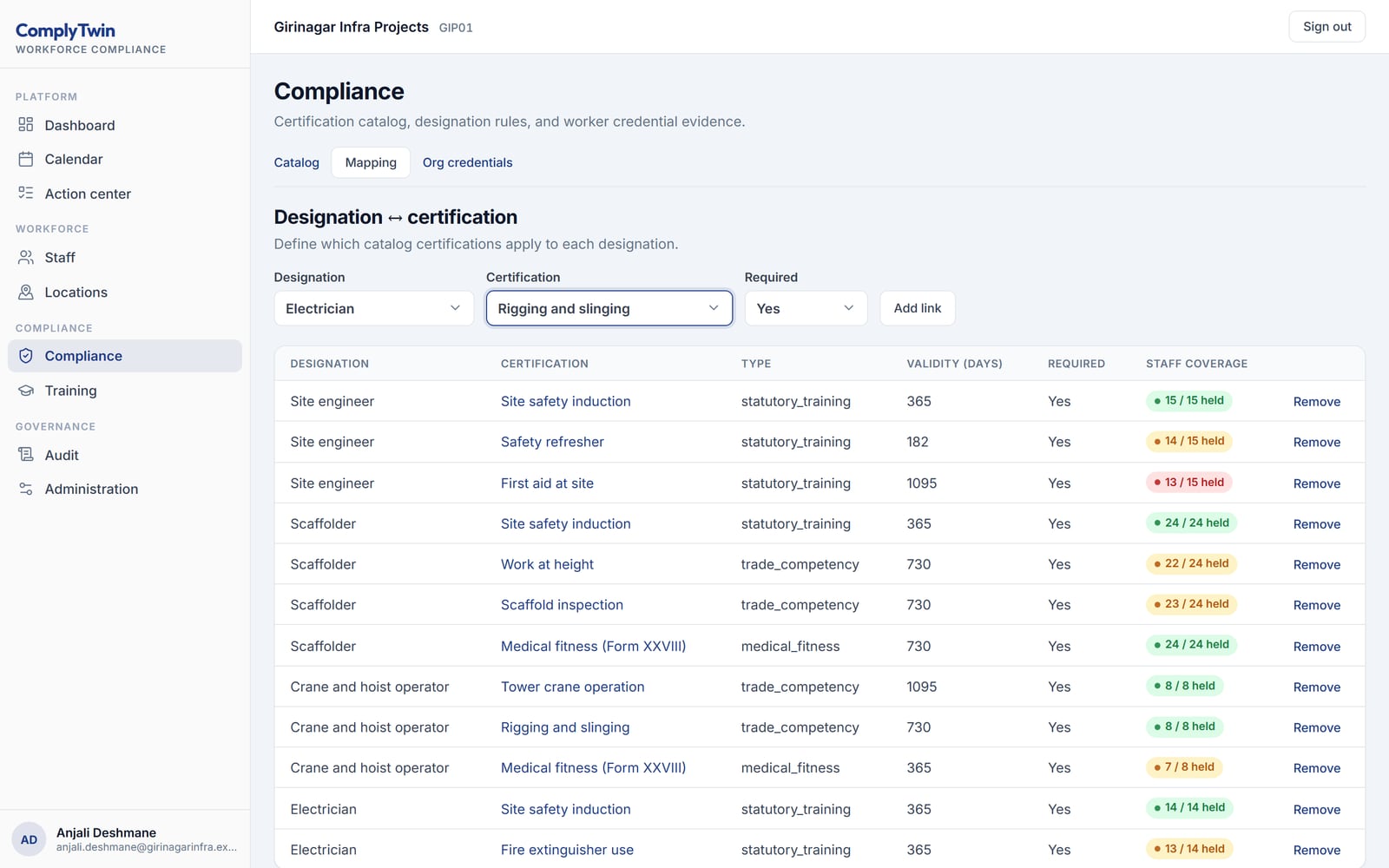
- How long a certificate, licence, training record or insurance remains good for. Validity is a property of the qualification, not of the person — 730 days for work at height, 365 for an operator medical — so the register holds it once per requirement rather than once per worker.
- Credential
- Anything a person must hold to do the work — also called a competency card, a ticket, a certification or a licence depending on the trade. What matters operationally is the same in every case: who holds it, when it ends, and whether anyone has checked the document itself.
- Inspection type
- A checklist, a cadence and the evidence that closes it. Property and collateral condition surveys, safety and EHS inspections, facility and building inspections, equipment and asset inspections and food safety audits are all inspection types rather than separate products, which is why adding one is configuration rather than a new deployment.
- EHS
- Environment, Health and Safety — the function responsible for the inspections, findings and corrective actions that keep a workplace lawful and survivable. An EHS inspection differs from a quality inspection in what it is looking for, not in how it is recorded.
- Property condition survey
- Somebody attends a property and records its state, usually in photographs, for a reader who was not there and who reads it months later. Lenders call the same thing a collateral inspection when it supports a loan. It is the case where evidence matters most, because the person relying on it cannot go and look.
- Field capture
- Recording an inspection where the work is, on a phone, rather than writing it up afterwards. The distinction that makes it worth anything is that photographs are taken in the application rather than chosen from a gallery, and each carries the place and the time the shutter fired rather than the time it reached the server.
- Audit trail
- The record of who did what and when, kept so that a past state can still be read after a later one replaces it. An append-only trail is one nothing can quietly revise — entries are added, never edited, so a verification from March survives the obligation being re-evidenced in September.
- Toolbox talk
- A short briefing delivered at the workplace, usually before a shift, on one specific hazard or procedure. It counts as training for compliance purposes, which means it needs an attendance record, and that record is the thing an inspector asks for rather than the talk itself.
- Site safety induction
- The briefing a worker must complete before being allowed onto a site, and the most common thing to find expired at the gate. It renews on a period like any other credential, which is why it belongs in the same register rather than in a separate folder.
- HACCP
- Hazard Analysis and Critical Control Points — the framework food businesses use to identify where contamination can occur and to record the checks that control it. In practice it produces a cadence of recurring checks with evidence, which is the same shape as every other obligation here.
Sazinga Comply is built around exactly these concepts — an obligation, its evidence, the person who verified it and the date it expires are things it already knows about rather than fields you invent. See what it does, how one obligation runs from the clause to the closed finding, or what it costs. More on how we think about this kind of work is in insights.
Frequently asked questions
What is the difference between a finding and a non-conformity?
Usually nothing. Different standards and different industries use finding, non-conformity, observation and defect for the same object — a checklist item that failed. What matters is whether the thing carries an owner and a due date from the moment it is raised, and whether it can be closed without attaching the evidence that it was actually put right.
Is a credential the same as a competency card?
Yes, and also the same as a ticket, a certification and in many cases a licence. The word changes by trade and by country. The operational question does not: who holds it, when does it end, and has anybody checked the document rather than the claim.
What does append-only actually mean here?
Entries are added and never edited. A verification recorded in March stays readable after the same obligation is re-evidenced in September, so the question an auditor asks — what did this record say at the time — has an answer. It does not prevent somebody with database owner credentials from rewriting history, and nothing claiming otherwise should be believed.
Why is an inspection type not a separate product?
Because an inspection type is a checklist, a cadence and the evidence that closes it, and those three things are the same whether the subject is a fire door, a food preparation surface, a scaffold or a building being surveyed for a lender. The checklist differs; the machinery around it does not.
Ready to see Comply on your own numbers?
Know what is due, what is evidenced and what has expired. Tell us how it runs where you are — what is kept by hand, what arrives late, and what it costs when it goes wrong — and we will answer against your own figures rather than against the glossary page you have just read.
Thank you — that has reached us
Your enquiry is with the team. We read every one ourselves and normally reply within one working day.
If it is quicker to talk, reach us directly:
While you wait — the platform overview covers what each application does, and Insights is our writing on building this kind of software.
Would rather read than write? See the screens — real captured ones, no sign-in.