
The words this trade actually uses
Definitions written for somebody pricing fabrication, not for a dictionary. Where two terms are used interchangeably in conversation and mean different things on an invoice, this says so.
CPQGradeGaugeConversion factorRate masterMaterial slotBill of materialsCutting listNestingBending allowanceTray type topUndershelfSplashbackBaffle filterMargin on sellingClient typeRevisionGST, CGST, SGST, IGST
- CPQ also: Configure, price, quote
- Software that takes a configurable product, applies pricing rules to the chosen configuration, and produces a quotation. For made-to-order fabrication the configuration is mostly dimensions and material, which is why a catalogue-driven CPQ built for standard products does not fit the trade.
- Grade also: 202, 304, 316
- The stainless alloy. 202 is the cheapest of the three and the least corrosion resistant; 304 is the general-purpose grade most commercial kitchen work is made in; 316 adds molybdenum and is specified where there is salt or heavy chemical cleaning. Grade changes the price per kilogram, not the geometry, which is why a quoting system should reprice a job from the grade rather than treat it as a note on the line.
- Gauge also: SWG
- Sheet thickness, expressed as a gauge number that runs backwards — a higher number is a thinner sheet. In this trade 16 SWG is about 1.6 mm and 18 SWG about 1.2 mm. Gauge drives weight, and since sheet is bought by weight, it drives cost.
- Conversion factor
- The number that turns a size into a purchasable quantity — for sheet, kilograms per square inch at a given gauge. It exists because a shop buys steel by weight and consumes it by area, and a pricing formula has to cross that boundary somewhere explicit rather than by somebody remembering a multiplier.
- Rate master also: Rate card
- The single list of what materials and labour cost: vendors, grades, groups, items with their unit and rate, and labour rates under short codes. Its whole value is that it is one list — when steel moves you change it once, rather than in eleven spreadsheets.
- Material slot
- A named place in a pricing formula where a material goes — a sheet slot, a tube slot, a hardware slot — constrained to a group so only sensible items can fill it. At quote time the slot is filled from the chosen grade and its rate enters the arithmetic.
- Bill of materials also: BOM, BOQ
- What a job consumes, aggregated across every line of the quotation: so much sheet, so much tube, so many feet and bowls. Produced from the priced quotation rather than rebuilt from the drawing, so the shop and the customer are working from the same job.
- Cutting list
- The flat pieces a job breaks down into, with their sizes — a top panel at 76 by 34, an undershelf at 74 by 32 — before anything is bent. It is what the person at the shear works from.
- Nesting
- Arranging the cutting list onto standard sheet sizes so as few sheets as possible are bought. A rough nest is enough to answer the question that matters when quoting: how many sheets does this job need.
- Bending allowance
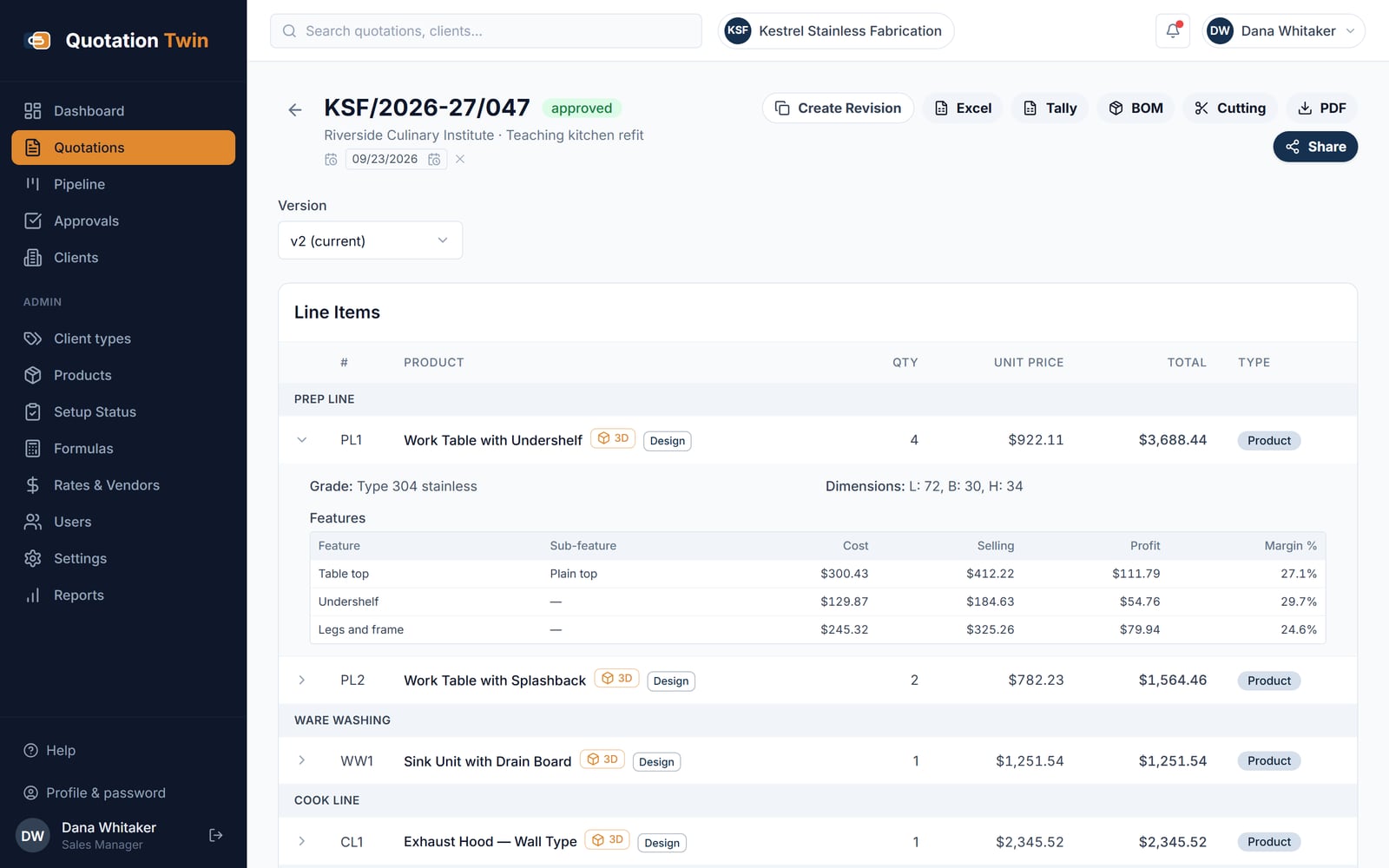
- The extra material a piece needs because it will be folded — the two inches all round that turn a flat sheet into a top with a lip. It is why a 72 by 30 table top is cut from a 76 by 34 blank, and why quoting from the finished size undercosts the job.
- Tray type top
- A work-table top pressed with a raised lip all round so spills stay on it, as against a plain top with a simple turn-down. It costs more in both sheet and labour, which is exactly the kind of option that belongs in a formula rather than in an estimator’s memory.
- Undershelf
- The lower shelf under a work table. Usually a lighter gauge than the top, because nothing is chopped on it.
- Splashback
- The upstand at the back of a table or sink that stops water and grease reaching the wall. Priced per running length rather than per area, since its height is standard.
- Baffle filter
- The removable stainless filter in an exhaust hood that catches grease. Hoods are quoted with roughly one filter per sixteen inches of run, so the count falls out of the hood length rather than being specified separately.
- Margin on selling
- Profit expressed as a share of the selling price, not of cost. A 20 per cent margin on selling is a 25 per cent markup on cost, and quoting one while meaning the other is a common and expensive way to lose money on a won job.
- Client type
- The segment a customer belongs to — direct, hotel chain, contractor — carrying its own margin. Attaching the margin to the type rather than to the estimator is what stops the same job being quoted three different ways on three different days.
- Revision also: Version
- A new copy of a quotation with its own number and history, made when the scope changes. The point of keeping the old one is that what was sent in March is still what was sent in March when the argument happens in July.
- GST, CGST, SGST, IGST
- Indian goods and services tax. A sale within your own state is split into central and state halves (CGST and SGST); a sale across a state line is a single integrated tax (IGST). On a fabrication quotation the charges that go into the taxable amount — transport, installation, commissioning — matter as much as the rate.
Where these turn into money
Every one of these terms is a place a quotation can go wrong: a gauge nobody updated, a bending allowance left out, a margin taken on the wrong base. How Sazinga Quote works walks through where each of them sits, and the features page says which part of the software holds it.
The vocabulary is drawn from stainless work for commercial kitchens, but the same terms carry into general metal fabrication and interior fit-out, where the material changes and the arithmetic does not.
Frequently asked questions
What is the difference between a grade and a gauge?
Grade is the alloy — 202, 304, 316 — and it changes the price per kilogram without changing the shape of the piece. Gauge is the thickness of the sheet, written as a number that runs backwards, so a higher gauge is a thinner sheet. Gauge changes how much metal the piece weighs; grade changes what that weight costs. A quotation needs both, and confusing them is one of the commoner ways a price comes out wrong.
Why does a bending allowance change the price?
Because the blank is bigger than the finished part. A table top measuring 72 by 30 with a lip all round is cut from something nearer 76 by 34, and the extra four inches in each direction are metal you have bought. Pricing from the finished size rather than the blank undercosts every folded piece on the job, quietly and consistently.
Is a margin on selling the same as a markup on cost?
No, and the gap widens as the number rises. A 20 per cent margin on selling is a 25 per cent markup on cost, because one is a share of the price and the other a share of what the job consumed. Holding the margin against the client type rather than in an estimator’s head is what stops the two being swapped on a busy day.
Why does a conversion factor need to exist at all?
Because a shop buys steel by weight and consumes it by area. Somewhere between the size on the drawing and the rupees on the quotation, square inches have to become kilograms, and that step depends on the gauge. Naming it as a conversion factor on the material item puts it somewhere explicit and auditable rather than inside a multiplier somebody remembers.
Ready to see Quote on your own numbers?
The pricing formula, out of the spreadsheet and under control. Tell us how it runs where you are — what is kept by hand, what arrives late, and what it costs when it goes wrong — and we will answer against your own figures rather than against the glossary page you have just read.
Thank you — that has reached us
Your enquiry is with the team. We read every one ourselves and normally reply within one working day.
If it is quicker to talk, reach us directly:
While you wait — the platform overview covers what each application does, and Insights is our writing on building this kind of software.
Would rather read than write? See the screens — real captured ones, no sign-in.