
The words this trade actually uses
Half of these mean different things in India, Britain and America, and a media owner explaining “face” or “proof of display” to a new client has nowhere to point. So: plain definitions, as the words are used on the ground.
Jump to
- Out-of-home advertising (OOH)
- Advertising that reaches people outside the home — billboards, hoardings, unipoles, gantries, transit and digital screens. In India the whole category is often just called "outdoor". Media owners sell space on these structures; advertisers and agencies buy it.
- Hoarding
- In India and much of South Asia, a hoarding is a large outdoor advertising structure — what American English calls a billboard. (In British construction usage the same word means a temporary barrier around a building site, which is a different thing entirely.) A hoarding management system and a billboard management system are the same product under two names.
- Billboard
- A large outdoor advertising panel, usually mounted at height beside a road. Sold by the month in most Indian markets, and priced by size, lighting, traffic and the junction it faces.
- Unipole
- A billboard carried on a single steel column rather than a lattice frame. Common on highways and at junctions because it needs a small footprint, and usually commands a higher rate than a wall-mounted panel of the same size.
- Gantry
- A structure spanning the road, carrying advertising above the traffic. High visibility, usually the most expensive inventory a media owner holds, and often subject to the tightest municipal permissions.
- Face
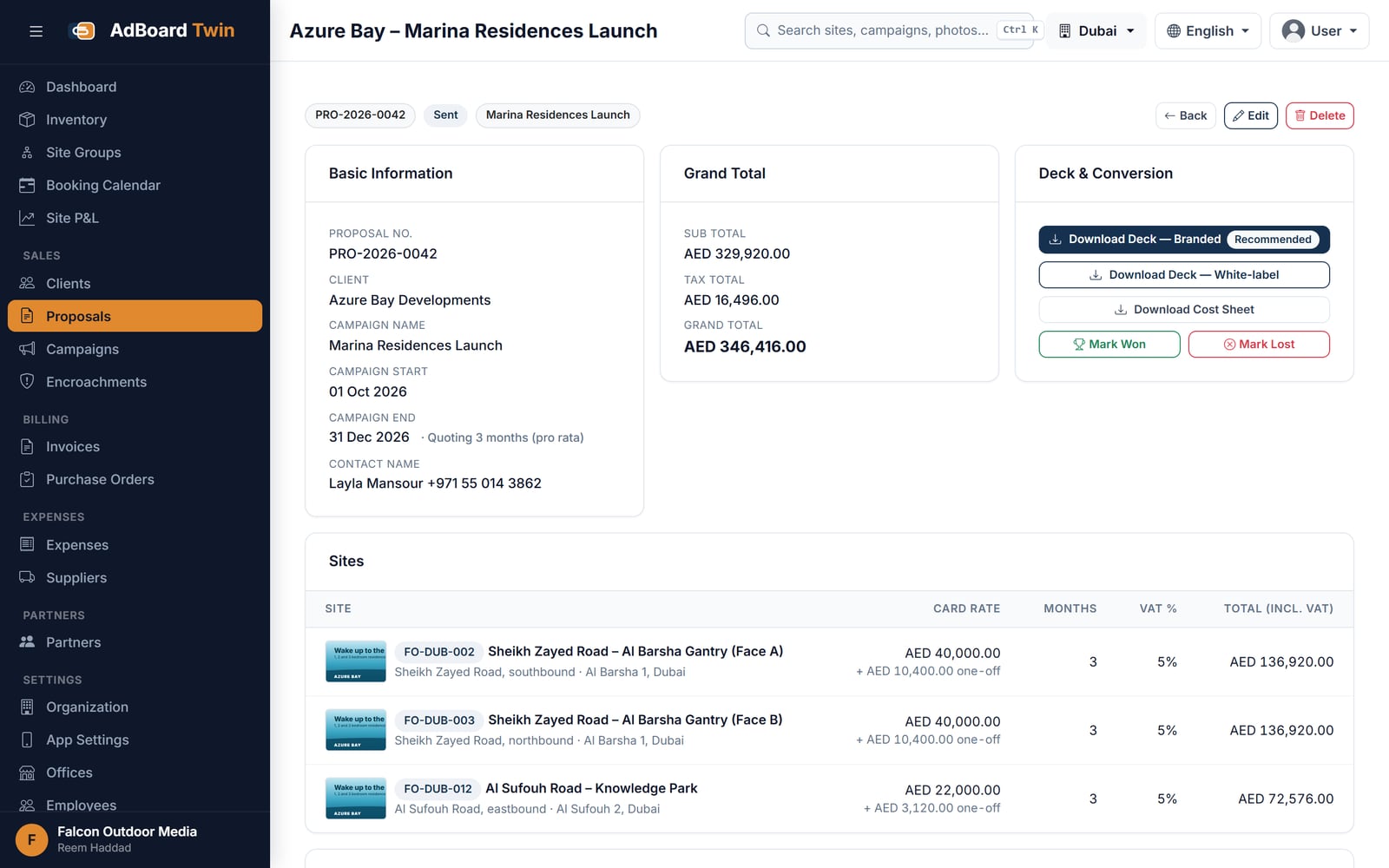
- One advertising surface on a structure. A single hoarding may carry two faces pointing in opposite directions, and each is booked and billed separately. Availability is tracked per face rather than per structure, which is why "how many sites do you have" and "how many faces can you sell" are different questions.
- Occupancy
- The proportion of a media owner’s faces that are booked over a period. The single most watched number in the business, because unsold days cannot be recovered — an empty face earns nothing and the day does not come back.
- Proof of display (POD)
- Photographic evidence that an advertisement was actually mounted and displayed as booked. Usually geotagged and dated, captured at installation, during the run and sometimes at night to show illumination. Clients increasingly make payment conditional on receiving it.
- Mounting and printing charges
- Costs charged on top of the display rate: printing the flex or vinyl, and the labour and access equipment to fit it. Quoted separately from rent because the client may supply their own printed material.
- Card rate
- The published monthly rate for a face, before negotiation. The rate actually agreed is often lower, which is why what was quoted last time — and to whom — matters more than the card rate when a client rings back.
- Purchase order (PO)
- The document by which a client authorises spend, naming the sites, the period and the amount. When an invoice does not match the PO — a date moved, a site swapped — payment stops until somebody reconciles the two.
- Media owner
- The business that owns or leases the structures and sells the advertising space on them. Distinct from the agency, which buys space on behalf of a brand. Software for a media owner is about inventory, availability and getting paid; software for an agency is about planning and buying.
- DOOH (digital out-of-home)
- Out-of-home advertising on electronic screens rather than printed material. Sold in time slots shared between advertisers rather than as an exclusive month, so the same screen carries several campaigns at once.
- Site code
- The internal reference a media owner gives each structure, usually encoding city and sequence. It is what makes a conversation about "the Gangapur Road one" precise enough to bill from.
Sazinga AdBoard is built around exactly these concepts — faces, occupancy, mounting charges and proof of display are things it already knows about rather than fields you invent. See what it does, how a site moves from vacant to paid, or where it fits in outdoor media. More on how we think about this kind of work is in insights.
Frequently asked questions
What is the difference between a hoarding and a billboard?
They are the same thing under two names. In India and much of South Asia a large outdoor advertising structure is a hoarding; American English calls it a billboard. British construction usage means something else entirely by the word — a temporary barrier around a building site — which is why the two terms are worth separating explicitly.
Why is availability tracked per face rather than per site?
A single structure may carry two faces pointing in opposite directions, and each is booked and billed separately. That is why "how many sites do you have" and "how many faces can you sell" are different questions, and why a booking calendar that works at site level will eventually sell the same surface twice.
What is proof of display, and why do clients ask for it?
Photographic evidence that an advertisement was actually mounted and displayed as booked — usually geotagged and dated, captured at installation, during the run and sometimes at night to show illumination. Clients increasingly make payment conditional on receiving it, so it is a receivables problem as much as a reporting one.
Is software for a media owner the same as software for an agency?
No. A media owner owns or leases the structures and sells the space, so their software is about inventory, availability and getting paid. An agency buys space on behalf of a brand, so theirs is about planning and buying. Sazinga AdBoard is built for the media owner.
Ready to see AdBoard on your own numbers?
Every site, every booking, every invoice — in one place. Tell us how it runs where you are — what is kept by hand, what arrives late, and what it costs when it goes wrong — and we will answer against your own figures rather than against the glossary page you have just read.
Thank you — that has reached us
Your enquiry is with the team. We read every one ourselves and normally reply within one working day.
If it is quicker to talk, reach us directly:
While you wait — the platform overview covers what each application does, and Insights is our writing on building this kind of software.
Would rather read than write? See the screens — real captured ones, no sign-in.